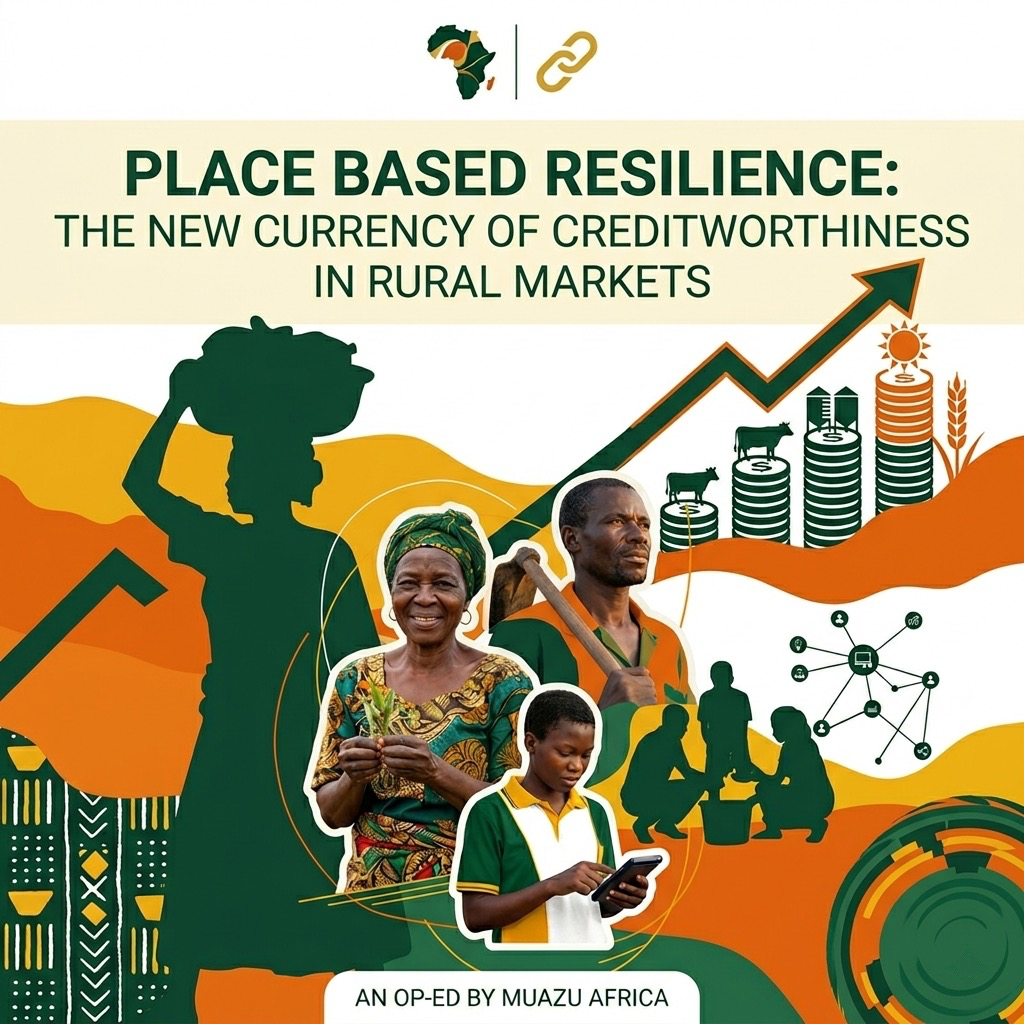
Place-Based Resilience:
The New Currency of Creditworthiness
in Rural Markets
Nigeria has 105 million rural citizens — nearly 47% of its population — who together form one of the most consequential and chronically underserved economic communities on earth. They are not a footnote to Africa’s growth story. They are its foundation.
I.
The Intelligence Gap at the Heart of Rural Finance
I spent years covering frontier markets from a Wall Street desk. I tracked bond spreads on sovereign debt, profiled the balance sheets of Lagos conglomerates, and wrote about West Africa’s emerging capital corridors for audiences in New York and London. And yet the deeper I went into Nigeria’s economic terrain, the clearer one thing became: the most consequential economic actors in the country were almost entirely invisible to the financial system that was supposed to serve them.
Not invisible because they were small. Not invisible because they were unproductive. Invisible because the models used to assess creditworthiness had been built in London and Washington — calibrated against collateral registries, formal payslips, and credit bureau data that simply did not exist in Kogi State or Kebbi or the smallholder belts of Benue. The instruments of finance had been designed for another economy, and applied wholesale to one they did not understand.
That gap is not an accident of history. It is the result of a fundamental misreading of what resilience looks like in rural markets. And it is costing Africa dearly.
“The instruments of finance had been designed for another economy — and applied wholesale to one they did not understand.”
Muazu Africa Research TeamII.
What Nigeria’s Resilience Index Reveals
Nigeria’s National Resilience Index — and the broader literature on community-level economic resilience — offers a critical lens through which to reread rural creditworthiness. The index, developed to measure household and community capacity to absorb, adapt to, and recover from shocks, consistently surfaces something that formal credit models miss: rural communities in Nigeria have developed extraordinarily sophisticated informal systems of risk distribution, resource pooling, and adaptive enterprise.
Ajo and esusu rotating savings groups in Yoruba and Igbo communities manage billions of naira in annual flows without a single formal financial instrument. Smallholder farmer clusters in the Middle Belt have built informal supply chain networks that outperform formal aggregators on price discovery and last-mile delivery. Rural women traders in northern Nigeria maintain decades-long credit relationships grounded entirely in social capital and reputational standing — forms of creditworthiness that are deeply real, deeply durable, and entirely unmeasured.
The resilience index quantifies what development practitioners have long observed anecdotally: rural communities are not fragile economic backwaters waiting for formal finance to rescue them. They are adaptive, networked, place-embedded economic systems operating with an entirely different — but entirely legitimate — credit grammar.
“Rural communities are adaptive, networked, place-embedded economic systems operating with an entirely different — but entirely legitimate — credit grammar.”
Muazu Africa Research TeamFor a country where 105 million people, contributing an estimated 26–35% of GDP through agriculture and rural commerce, live outside the reach of the formal financial system, this is not a philosophical observation. It is a fiscal emergency.
III.
Place-Based Resilience as a Credit Variable
The concept of place-based resilience reconceives creditworthiness not as a property of individuals divorced from context, but as an emergent property of the ecosystems within which those individuals operate. A farmer in Zamfara State with no credit score but access to a functional cooperative, proximity to an irrigation scheme, a decade of consistent cassava yield records, and a community-anchored distribution network is, in any meaningful sense of the word, creditworthy.
What distinguishes place-based resilience as a credit variable is its composite nature. It draws on ecological indicators — rainfall consistency, soil fertility, climate exposure — alongside institutional indicators such as cooperative density, market access, and value chain integration. It incorporates social cohesion metrics: conflict incidence, community trust levels, gender inclusion in enterprise. And it maps economic indicators: productivity trends, income diversification, and enterprise survival rates across economic shocks.
When Muazu Africa conducts enterprise diagnostics in rural communities, this is precisely what we are building: a granular, place-specific intelligence layer that translates lived economic experience into legible data for institutional investors, development finance institutions, and program designers who currently have no reliable mechanism for understanding the communities they seek to serve.
The Data That Already Exists
One of the most important insights from Nigeria’s rural resilience literature is that the data problem is less severe than assumed. Nigeria’s National Agricultural Sample Survey, combined with NIMC’s growing biometric infrastructure, state-level land use records, commodity board transaction histories, and mobile money flow data from fintech operators now active in rural geographies, creates a fragmentary but increasingly coherent picture of rural economic activity.
The gap is not the absence of data. The gap is the absence of institutions capable of assembling, interpreting, and translating that data into investment-grade intelligence. That is precisely the gap that rural enterprise intelligence work exists to fill.
IV.
105 Million People and the Investment Frontier They Represent
Nigeria’s rural population of 105 million is not a development problem to be managed. It is an investment frontier to be understood. The figures are striking when assembled: rural Nigeria contributes disproportionately to the country’s agricultural GDP, which itself represents approximately 25% of overall GDP. Agricultural exports, dominated by rural smallholder and small enterprise activity, have generated over $3.5 billion in foreign exchange earnings in recent years.
Rural value chains — cocoa in Ondo and Cross River, sesame in Benue and Nasarawa, ginger in Kaduna, aquaculture along the Niger Delta waterways — represent globally competitive production corridors that are chronically underfinanced relative to their productive capacity. The World Bank estimates that a 10% increase in agricultural productivity in Sub-Saharan Africa generates GDP gains two to three times larger than equivalent productivity increases in any other sector.
“Nigeria’s rural population of 105 million is not a development problem to be managed. It is an investment frontier to be understood.”
Muazu Africa Research TeamAnd yet the average DFI-backed enterprise development program in Nigeria still begins its geographic targeting with Lagos or Abuja. Still defaults to cohorts of entrepreneurs with smartphones, bank accounts, and attendance at a business school pitch competition. Still measures success by the number of enterprises formalized — as though informality and resilience were mutually exclusive categories.
They are not. Place-based resilience tells us that some of the most durable enterprises in rural Nigeria are precisely those that have remained outside formal systems: flexible, adaptive, community-anchored, and invisible to the credit models that would otherwise capture and constrain them.
V.
What This Means for Institutions
For development finance institutions, foundations, and governments designing the next generation of rural enterprise programs, the implications are direct.
First, investment thesis design must incorporate place-based resilience scores alongside traditional financial indicators. A community’s historical recovery rate from drought, flood, or commodity price shocks is a more reliable predictor of enterprise survival than a single year of audited accounts. Institutions that learn to read place-based signals will build better pipelines.
Second, enterprise support programming must move from generic capacity-building models toward ecosystem-specific interventions. Rural enterprises in Kano’s groundnut belt need a different intervention architecture than rural enterprises in Ogun’s cassava corridor. The topography, the value chain dynamics, the climate exposure, and the community institutional fabric are all different. Programs that treat rural Nigeria as a homogeneous beneficiary class will continue to underperform.
Third, MEL frameworks must be redesigned to capture resilience indicators, not just output metrics. Counting the number of SMEs trained, or the number of businesses registered, captures activity — not durability. What matters is whether enterprises survive the next drought, the next commodity price shock, the next infrastructure disruption. Measuring that requires place-based baseline data collected before the program begins.
The Role of Rural Enterprise Intelligence
Before institutions can design place-appropriate programs, they need granular, verified intelligence about the enterprise ecosystems they are entering. Before investors can deploy capital into rural value chains, they need investment-grade data on enterprise density, productivity trends, value chain integration, and resilience factors across target geographies.
Muazu Africa’s diagnostics work — our enterprise baseline assessments, investment readiness scoring, and MEL framework design — is built precisely on this premise. We enter rural markets not as program delivery agents but as intelligence translators: taking the lived economic complexity of rural communities and rendering it legible to the institutions that need to act on it.
VI.
A New Credit Grammar for Rural Africa
The future of rural finance in Africa will not be built on credit scores modelled after FICO. It will be built on a new grammar — one that reads place-based resilience, community institutional density, value chain integration, and adaptive enterprise capacity as the primary signals of creditworthiness.
That grammar is already being written in the ajo meetings of southwest Nigeria, in the herder-farmer agreements of the Middle Belt, in the cassava cooperatives of Anambra and the sesame exporter networks of Benue. It is being written in the transaction records of mobile money operators extending into rural geographies, and in the output data flowing from thousands of smallholder clusters that have been quietly increasing productivity without a single formal loan.
Nigeria — with its 105 million rural citizens, its extraordinary ecological and cultural diversity, and its deepening infrastructure of resilience — is the single most important laboratory for this new grammar on the African continent. Getting it right here, building the intelligence infrastructure to make place-based resilience legible and investable here, will have implications that reach far beyond the Niger Delta and the Sahel.
“Place-based resilience is not a soft metric. It is the hardest signal in rural markets. And it is time the institutions that matter started reading it.”
Muazu Africa Research Team · 2026Muazu Africa exists at that frontier. We bring the analytical rigour of development finance, the on-the-ground credibility of enterprise practitioners, and the intellectual commitment to making rural economic complexity visible — to institutions, to investors, and to the policymakers who will shape Africa’s next economic chapter.
Muazu Africa is a rural enterprise intelligence and ecosystem development firm working with development finance institutions, governments, foundations, and corporates across Africa. We design and implement programs that strengthen rural enterprises, build investment pipelines, and generate measurable economic impact.
Registered with SMEDAN as an Enterprise Development Provider, Muazu Africa has trained over 2,500 rural SMEs and partnered with institutions including the Mastercard Foundation, Sterling One Foundation, and the Federal Ministry of Education.
Tv