Reserve Your Place
Loading…
Secure your spot before registration opens. We’ll notify you directly with programme details, dates, and payment instructions.
You’re on the list!
We’ve received your registration for . We’ll be in touch with programme details and payment instructions.
Questions? Email [email protected] or message us on WhatsApp.
Training & Learning Hub
Professional trainings, masterclasses, and ecosystem learning sessions on rural enterprise systems, frontier markets, gender inclusion, and capital mobilisation. Practical learning that builds lasting rural prosperity.
Paid Trainings & Masterclasses
Structured learning with direct practitioner application. Active programs have live registration and payment links. Upcoming programs use the waitlist form.
Rural Women Founders Lab
A specialised training program supporting women founders building rural and frontier enterprises across agriculture, climate, health, and energy systems. Focused on enterprise growth, capital readiness, and value chain expansion.
- Enterprise growth frameworks for rural founders
- Capital readiness and investor preparation
- Value chain mapping and expansion strategies
- Gender-responsive financial instruments
- Peer learning and cohort sessions
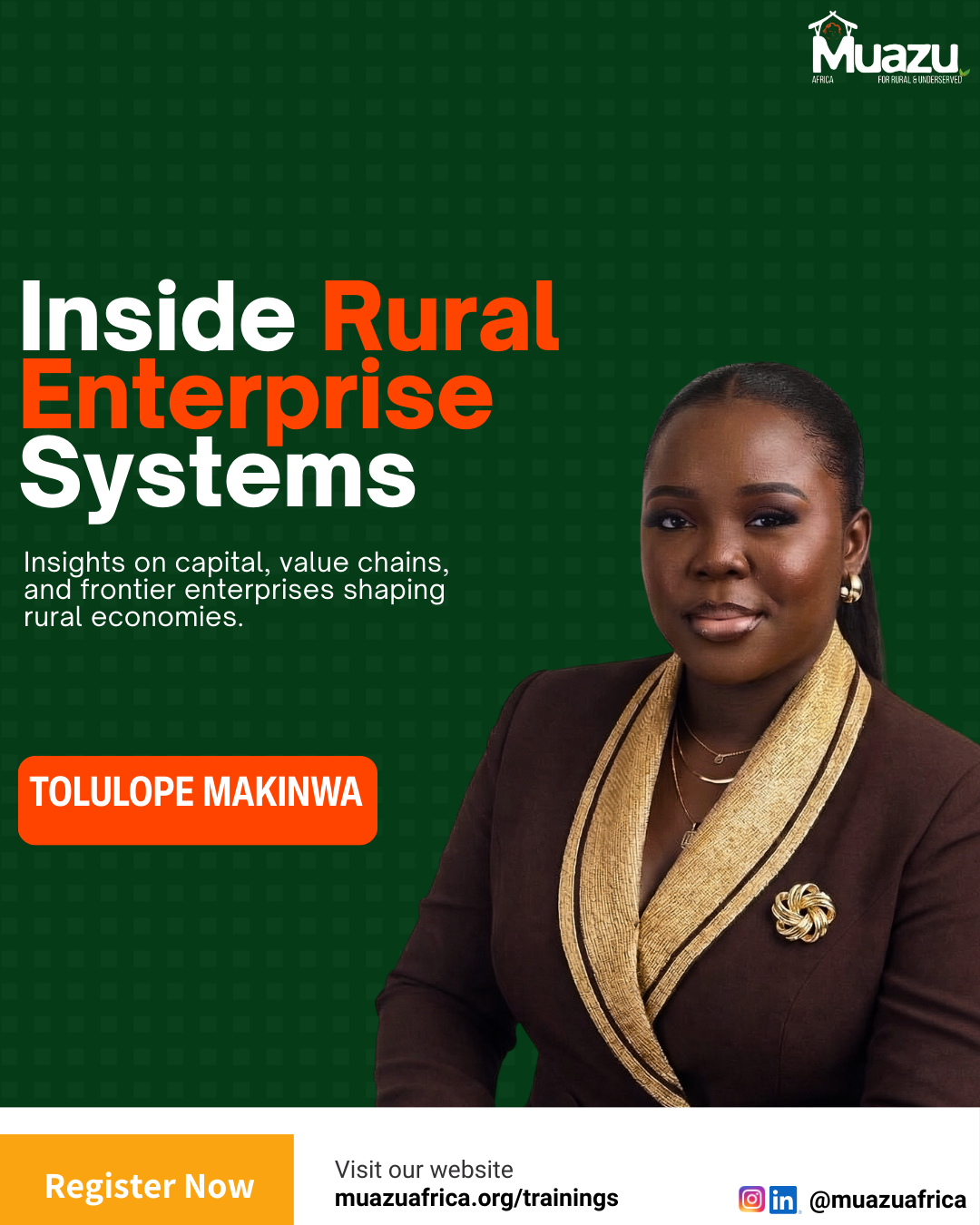
Inside Rural Enterprise Systems
A masterclass exploring how rural enterprise systems function, where value leaks occur in rural economies, and how investment capital can unlock frontier markets across Africa.
- How rural enterprise systems are structured
- Identifying and measuring value leakage points
- Unlocking frontier market investment opportunities
- Rural deal flow and institutional capital
- Practical diagnostic frameworks
Rural Enterprise Investment Readiness Bootcamp
A hands-on bootcamp equipping rural enterprise leaders with the financial models, due diligence preparation, and investor language needed to access institutional capital.
- Building investor-grade financial models
- Due diligence documentation and data rooms
- Pitching to DFIs and impact investors
- Blended finance structuring basics
- GESI-aligned reporting for funders
Gender Lens Investing for Frontier Markets
A masterclass for investors and development practitioners applying gender lens frameworks to rural and frontier market portfolios. Covers GESI measurement, deal sourcing, and inclusive capital structuring.
- Gender lens investing frameworks and standards
- GESI data collection and disaggregation
- Women-owned enterprise deal sourcing
- Inclusive capital structuring and terms
- Portfolio monitoring with gender metrics
Capital Mobilisation for Rural Enterprises
A practical workshop on identifying, structuring, and accessing the right capital — grants, debt, equity, and blended instruments — for rural enterprises at different stages of development.
- Mapping capital landscape for rural enterprises
- Grants vs debt vs equity — when to use what
- Writing winning grant applications
- Structuring blended finance for rural contexts
- Building relationships with DFI programme officers
Frontier Markets Research Methods
A rigorous training on qualitative and quantitative research methods for frontier and rural markets. Designed for practitioners, researchers, and policy teams who need data that holds up to institutional scrutiny.
- Primary data collection in low-connectivity environments
- KoboToolbox, ODK, and mobile survey design
- SROI measurement methodology
- Rural prosperity index construction
- Presenting findings for policy and investor audiences
Rural Value Chain Intelligence Workshop
A deep-dive workshop on mapping, analysing, and redesigning rural value chains to reduce extraction, increase local retention, and connect producers to better-paying markets.
- Value chain mapping techniques and tools
- Identifying and quantifying leakage points
- Aggregation models and cooperative structures
- Post-harvest loss reduction strategies
- Market linkages and buyer relationship management
Ecosystem Surveys
Open research surveys — always free to participate.
Muazu Africa conducts ecosystem surveys to understand the realities of rural enterprise development, women-led businesses, and aggregation systems across Africa. All surveys are free and open — no payment required.
Women Aggregators Survey
A research survey examining the role of women aggregators in rural supply chains and agricultural markets. Your responses contribute to evidence-based advocacy and ecosystem intelligence.
More Surveys in Development
Additional surveys on rural energy access, gender-inclusive finance, and frontier market infrastructure are in development.
Upcoming Programs
Registration will open for each programme in sequence. Join the waitlist on any card above to be notified first.
Rural Enterprise Investment Readiness Bootcamp
Gender Lens Investing for Frontier Markets
Capital Mobilisation for Rural Enterprises
Frontier Markets Research Methods
Rural Value Chain Intelligence Workshop
Stay Notified on WhatsApp
Message us directly on WhatsApp for programme announcements, registration links, and dates.
Message on WhatsAppTraining Payments
Participants who have received a payment instruction can complete their training payments securely through Paystack.
Complete Your Payment
All training payments are processed through Paystack — a secure, PCI-compliant payment gateway. You will be redirected to the Paystack payment page in a new tab. Use the same email address you provided during registration.
Payments encrypted and processed by Paystack · SSL secured
Payment queries? Email [email protected]